TL;DR: Your clients are about to flip the switch on Microsoft 365 Copilot, Google Gemini, and a long tail of agentic AI tools. The question isn't whether to enable AI — it's whether their workspace is ready for it. AI Readiness is the new pre-rollout layer of the MSP service stack, and the MSPs who package it now win the AI conversation with their clients.
The Question Every MSP Is Now Getting
If you run an MSP in 2026, this conversation probably sounds familiar:
“Hey, our team wants to turn on Copilot next week. Can you just enable it?”
Then a week later, the same client asks if a second AI tool can have delegate access to every mailbox in their tenant. Or whether it's OK to point a third-party agent at their SharePoint sites. The questions are arriving faster than the answers.
A small MSP owner described the pattern in a community thread last month, lightly paraphrased here:
“We had a client try to grant an AI agent delegate access to every mailbox in their Entra tenant — and we only caught it because an admin alert fired. When you push back with ‘here are a million reasons this is a bad idea,’ the client just hears ‘my MSP is being uncooperative.’”
That's the bind. Saying “no” costs trust. Saying “yes” without doing the work costs everything else. What's missing is a third option: a fast, repeatable assessment you can run before any AI tool gets close to production.
Why Copilot Turns Latent Permissions Into Live Exposure
Microsoft is unambiguous about how Copilot accesses data: it can only return content the signed-in user already has permission to read. That sounds reassuring until you remember what most workspaces actually look like — years of inherited access, “anyone with the link” sharing, stale Teams sites, and SharePoint libraries with permissions no one has audited since the migration.
A SharePoint admin put it bluntly in a recent community thread (paraphrased):
“If your library permissions are already a mess — and let's be honest, whose aren't — the Copilot agent just inherits that mess. It doesn't clean anything up.”
Microsoft's own oversharing blueprint for Copilot tells the same story: Pilot, Deploy, Operate — with a Pilot phase that explicitly exists to surface oversharing before AI amplifies it. Industry analysts estimate roughly 15% of business-critical files in a typical tenant are at risk due to oversharing or misconfigured access, and nearly 70% of security teamsworry that AI assistants will expose sensitive data they didn't even know was reachable.
Microsoft's Own Advice to Partners: Lead With Readiness
In the March 2026 Microsoft Partner Copilot monthly briefing, Microsoft told partners to lead with readiness as Stage 1 of every Copilot conversation. Their words:
“Many Copilot conversations stall because customers cannot see what needs to be true before they adopt. Readiness removes that friction.”
Microsoft's recommended packaged offer for partners is exactly what we've been telling MSPs for the last year: don't sell Copilot. Sell readiness, then Copilot, then continuous protection.It de-risks the rollout, justifies budget, and opens the door to deeper engagement on identity, sharing, and data governance — the foundations every AI conversation will keep coming back to.
What Goes Wrong When MSPs Skip Readiness
Three failure modes show up over and over:
- The week-6 stall.Most Copilot deployments hit a governance wall between weeks 6 and 12. Adoption flattens, security teams panic, and licenses sit unused. Microsoft's own remediation playbook is essentially “the readiness work you should have done first.”
- The CEO's inbox moment.An employee asks Copilot a benign question. Copilot returns a synthesized answer drawn from a board deck, an HR file, or an executive's draft email — all technically within the user's permissions, all completely unintended. The conversation that follows is not a fun one for the MSP.
- The shadow agent.A user wires up a third-party AI agent with delegated permissions across the tenant before the MSP knows it exists. There's no audit trail, no scope, and no remediation plan — and the user genuinely thought they were helping.
What Cyflow AI Readiness Actually Checks
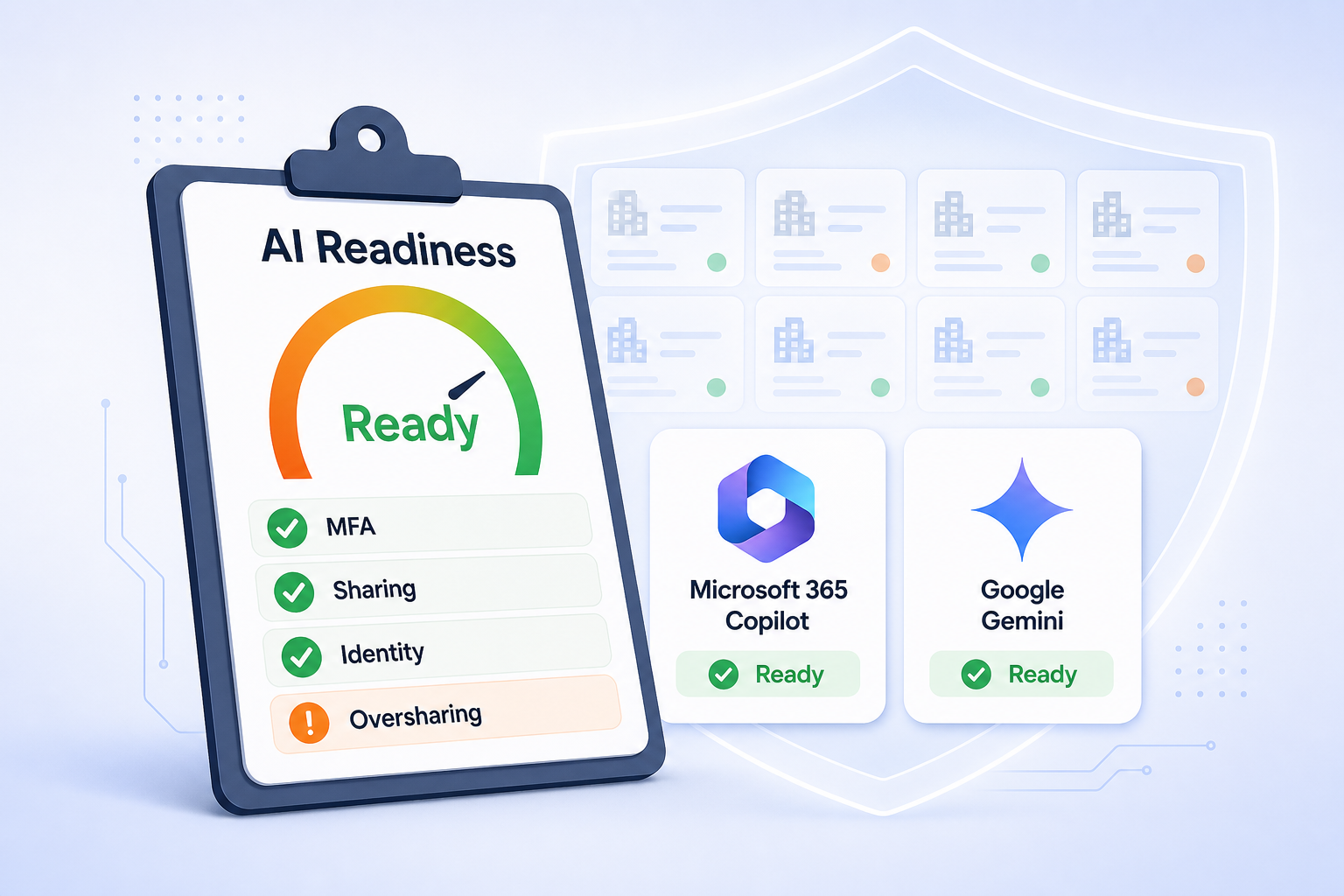
Cyflow AI Readinessis the pre-rollout assessment built for the way MSPs actually work: 30-second OAuth onboarding, multi-tenant from day one, and first signals in minutes — not the 8-day manual audit cycle.
For each client tenant, the assessment surfaces:
- Sensitive files exposed to AI— what Copilot or Gemini could surface today based on current permissions.
- Oversharing & public links— org-wide shares, “anyone with the link” documents, and external access patterns that AI will inherit.
- Shadow AI & risky OAuth apps— the third-party agents and tools already touching workspace data, including ones the client never told you about.
- Identity & MFA gaps— users without MFA, stale privileged accounts, and conditional access blind spots that turn into AI access blind spots.
- Prioritized remediation roadmap— not a 1,200-row spreadsheet, but a sequenced list of fixes you can quote, schedule, and bill.
The deliverable is a structured assessment report you can hand to a client's security lead or executive sponsor — and a live console that lets you re-run the assessment after remediation to prove progress.
Where AI Readiness Fits in an MSP Service Motion
The MSPs winning AI right now are running this play:
- Open the AI conversation with readiness, not licensing. When a client asks “can we turn on Copilot?”, the answer is “let's find out — we'll know in a few hours.”
- Run the assessment as a packaged engagement. Fixed scope, fixed price, fixed deliverable. It builds credibility and uncovers remediation work that pays for itself many times over.
- Convert remediation into managed services. Permissions cleanup, sensitivity labeling, OAuth governance, identity hardening — this is recurring work the client can't do alone.
- Hand off into continuous AI Protection. Readiness is point-in-time. The risks aren't. Continuous monitoring, drift detection, and automated remediation become the recurring revenue line that pays back year after year.
From Readiness to Continuous AI Protection
AI Readiness is how you safely say yes. AI Protection is how you keep saying it. Cyflow is built around both halves of that motion on a single platform — multi-tenant, MSP-native, and priced for the AI economy. Same console for Microsoft 365 and Google Workspace, same workflow for tenant #1 and tenant #100.
Run AI Readiness on Your Next Client Tenant
OAuth in 30 seconds. First signals in minutes. Prioritized remediation roadmap you can package as an engagement.
Sources
- Microsoft: Mitigate Oversharing to Govern Microsoft 365 Copilot and Agents
- Microsoft Partner: Copilot monetization for SMBs — lead with readiness (March 2026)
- Microsoft: Accelerating Copilot Adoption with Automated Readiness Assessment
- 2toLead: Microsoft 365 Copilot Governance in 2026 — Why Most Deployments Stall Without It
- NIST AI Risk Management Framework (AI RMF 1.0)